New Tariffs Take Effect July 22 Following USTR Investigation
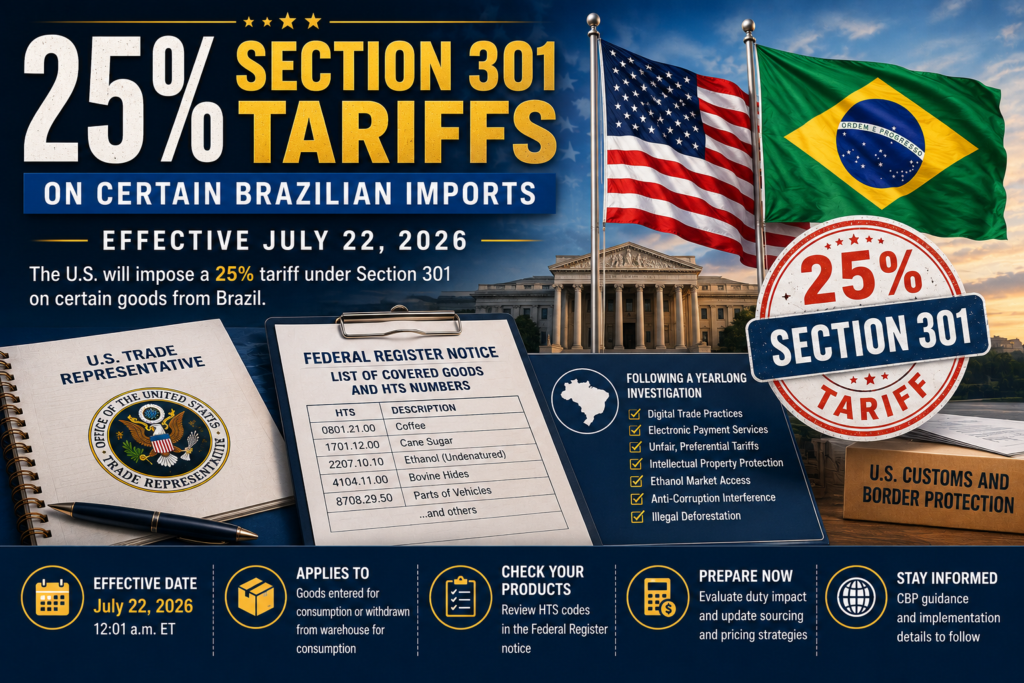
The Office of the U.S. Trade Representative (USTR) has announced that the United States will impose new Section 301 tariffs of 25% on certain products imported from Brazil.
The additional duties, directed by President Trump, will become effective at 12:01 a.m. ET on July 22 for covered goods entered for consumption or withdrawn from warehouse for consumption in the United States.
Importers purchasing products from Brazil should review their supply chains immediately to determine whether their products are included in the affected tariff classifications.
Why Are the New Tariffs Being Imposed?
The new duties follow a year-long investigation conducted under Section 301 of the Trade Act of 1974.
According to USTR, the investigation concluded that several Brazilian government policies and practices unfairly burden or restrict U.S. commerce.
The concerns identified by the United States include:
- Digital trade restrictions
- Electronic payment services
- Preferential tariff policies
- Anti-corruption enforcement concerns
- Intellectual property protection
- Limited market access for U.S. ethanol
- Illegal deforestation policies affecting trade
USTR also noted that it received more than 360 public comments during the investigation and engaged in extensive negotiations with the Brazilian government before deciding to impose the additional tariffs.
When Do the Tariffs Take Effect?
The new 25% Section 301 tariff will apply to covered Brazilian products:
- Effective Date: July 22
- Effective Time: 12:01 a.m. Eastern Time
- Applies to qualifying goods entered for consumption or withdrawn from bonded warehouse on or after the effective date.
Only products specifically identified in the Federal Register notice will be subject to the additional duty.
What Importers Should Do Now
Companies importing products from Brazil should begin preparing before the effective date.
Recommended actions include:
- Review affected HTS classifications
- Identify shipments arriving on or after July 22
- Calculate the financial impact of the additional 25% duty
- Evaluate inventory and purchasing strategies
- Consider alternative sourcing where appropriate
- Consult with your customs broker regarding compliance requirements
Early planning can help minimize unexpected duty costs and avoid supply chain disruptions.
How Section 301 Tariffs Work
Section 301 of the Trade Act of 1974 authorizes the U.S. government to impose additional duties when it determines that another country’s trade practices are unfair or discriminatory and negatively affect U.S. commerce.
Unlike Section 232 tariffs, which focus on national security, Section 301 tariffs are designed to address unfair trade practices and encourage changes in foreign government policies.
What Happens Next?
Additional implementation guidance is expected from U.S. Customs and Border Protection (CBP) regarding entry procedures and reporting requirements.
Importers should continue monitoring updates as CBP publishes operational guidance before the tariffs take effect.
Key Takeaways
- The United States will impose a 25% Section 301 tariff on certain imports from Brazil.
- The new duties become effective July 22.
- The tariffs result from a year-long USTR investigation into Brazilian trade practices.
- Only products listed in the Federal Register are subject to the additional duty.
- Importers should review affected HTS classifications and prepare for increased duty costs.