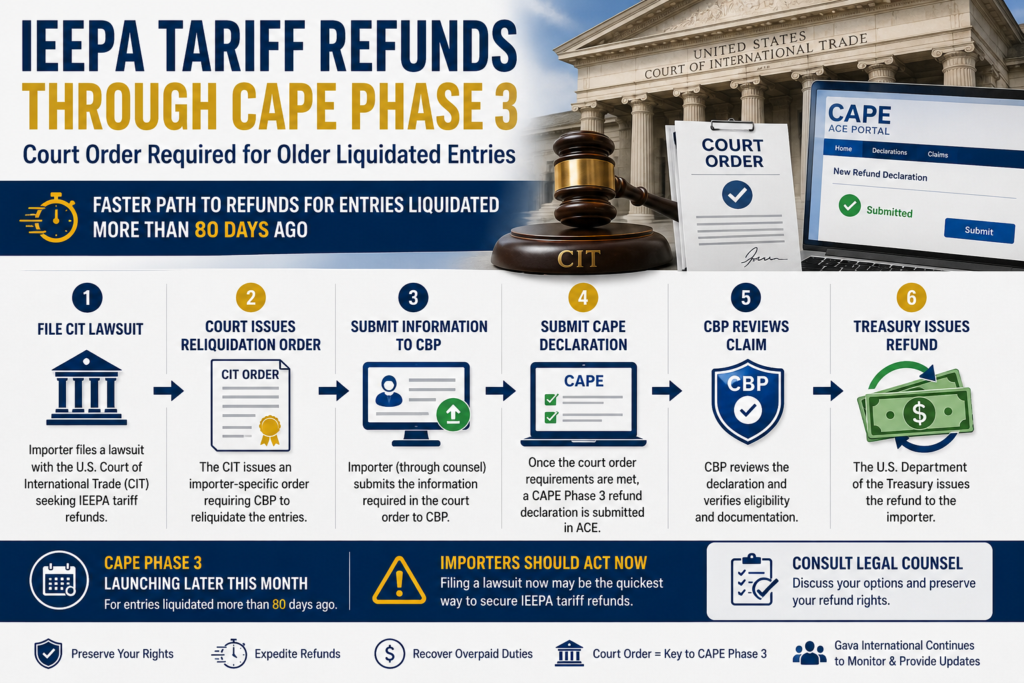
New Court Orders Open Faster Path to Refunds for Older Liquidated Entries
Importers seeking refunds of tariffs paid under the International Emergency Economic Powers Act (IEEPA) may now have a faster path to recovery.
Recent actions by the U.S. Court of International Trade (CIT), combined with U.S. Customs and Border Protection’s upcoming CAPE Phase 3 deployment, suggest that filing an individual lawsuit may be the quickest way to obtain refunds for entries that are finally liquidated and currently ineligible under earlier CAPE phases.
While litigation is not legally required at this time, businesses with significant IEEPA duties at stake should consult legal counsel to determine whether filing a case is the best strategy to preserve and accelerate their refund claims.
Why This Matters
CBP’s CAPE refund system has already begun processing eligible IEEPA refund claims through its initial phases.
However, entries liquidated more than 80 days ago generally cannot be refunded through CAPE unless the importer first obtains a court order directing CBP to reliquidate those entries.
This makes litigation an increasingly important option for many importers.
How CAPE Phase 3 Will Work
CBP has announced that CAPE Phase 3, expected to launch later this month, will support refund requests for older liquidated entries.
To qualify, importers will generally need to:
- File a lawsuit with the U.S. Court of International Trade.
- Obtain an importer-specific court order requiring reliquidation.
- Submit a CAPE declaration through the ACE Portal.
Once these steps are completed, CBP can process the refund through the CAPE system.
Court Already Issuing Orders
On July 15, the Court of International Trade began issuing reliquidation orders covering approximately 3,700 individual refund lawsuits.
These court orders instruct plaintiffs to provide specific information to CBP before submitting their CAPE refund declarations.
This development demonstrates that the court and CBP are actively coordinating the next phase of the IEEPA refund process.
What About Existing Protests?
Importers who have already filed administrative protests are not necessarily excluded.
If an importer later receives a court order qualifying them for CAPE Phase 3, the protest can generally be withdrawn so the refund may proceed through the CAPE process.
This provides additional flexibility while the legal process continues to evolve.
Should Importers File a Lawsuit?
Although importers generally have two years to file a lawsuit seeking IEEPA tariff refunds, waiting may delay access to refunds.
Several legal issues remain unresolved, including:
- Whether future CAPE phases will cover all protested entries.
- Whether class-action litigation could eventually eliminate the need for individual lawsuits.
- How the courts will ultimately define refund eligibility.
For companies with substantial refund exposure, filing a lawsuit now may provide the most direct path to recovering duties.
Recommended Next Steps
Importers with entries that:
- Were liquidated more than 80 days ago,
- Are not eligible under CAPE Phase 1 or Phase 2, and
- Involve significant IEEPA duties,
should consider discussing their options with experienced international trade counsel.
Early action may help preserve refund rights while positioning eligible entries for faster processing through CAPE Phase 3 once available.
Key Takeaways
- CAPE Phase 3 is expected to launch later this month.
- Older liquidated entries generally require a Court of International Trade order before refunds can be processed.
- The CIT has already begun issuing reliquidation orders for thousands of refund cases.
- Existing protests may still be withdrawn if a court order allows processing through CAPE.
- Importers with significant IEEPA refunds should consult legal counsel to determine whether filing a lawsuit is appropriate.