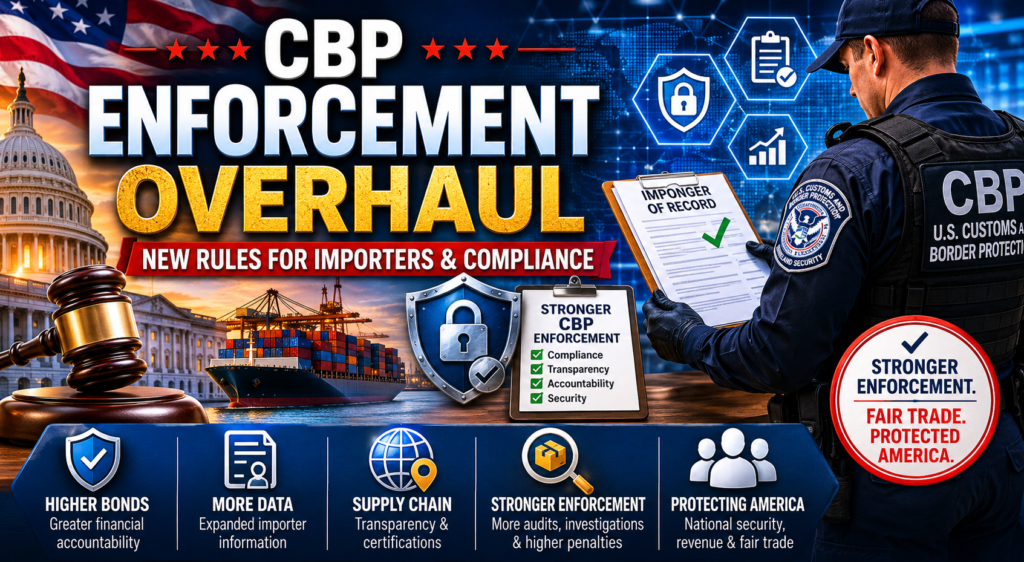
New Executive Order Signals Tougher Customs Enforcement and Higher Compliance Expectations
President Trump has signed a new Executive Order aimed at strengthening the enforcement capabilities of U.S. Customs and Border Protection (CBP), signaling a significant shift toward stricter importer oversight, stronger duty collection measures, and increased scrutiny of supply chains.
The order focuses heavily on the responsibilities of the Importer of Record (IOR) and seeks to close what the administration describes as long-standing loopholes that have allowed some importers to evade duties, misrepresent shipments, or avoid compliance with U.S. trade laws.
For businesses importing into the United States, the message is clear: CBP is expected to demand more transparency, stronger financial accountability, and greater documentation from importers in the coming months.
Why the Administration Is Taking Action
According to the Executive Order, outdated customs procedures and insufficient enforcement have created opportunities for bad actors to engage in practices such as:
- Undervaluing imported goods
- Misclassifying products to reduce duties
- Concealing ownership information
- Evading customs duties through complex business arrangements
- Circumventing supply chain compliance requirements
The administration argues that these activities not only reduce government revenue but also create unfair competition for compliant businesses, undermine national security, and expose consumers to risks associated with non-compliant imports.
Major Changes Expected for Importers of Record
One of the most significant aspects of the Executive Order is its focus on strengthening Importer of Record requirements.
Within 180 days, the Department of Homeland Security and CBP are expected to revise regulations and policies that govern importer eligibility.
Potential changes include:
Higher Bond Requirements
Importers may be required to maintain:
- Higher customs bond amounts
- Additional tangible assets in the United States
- Increased financial guarantees to ensure payment of duties and compliance with customs laws
The goal is to reduce the risk of unpaid duties and improve CBP’s ability to recover revenue when violations occur.
Expanded Importer Identification Requirements
Importers could soon be required to provide substantially more information to CBP, including:
- Ownership and beneficial ownership details
- Business affiliations
- Anticipated import volumes
- Domestic asset information
- Corporate organization data
These requirements would provide CBP with greater visibility into who is importing goods and who ultimately controls importing entities.
Increased Scrutiny of Foreign Importers
The Executive Order places particular emphasis on foreign-based Importers of Record.
Among the proposed changes:
- Foreign importers may face restrictions on using continuous customs bonds
- Additional financial guarantees may be required
- Certain foreign importers may need participation in CBP’s Customs Trade Partnership Against Terrorism (CTPAT) program
- Informal entry procedures may become more limited for foreign entities
The administration states that these changes are intended to place domestic and foreign importers on a more equal compliance footing while protecting U.S. revenue and domestic industry.
More Supply Chain Transparency Required
The Executive Order also directs CBP to establish enhanced disclosure and certification requirements.
Importers may be required to provide additional supply chain information, including:
- Manufacturer identifiers
- Product model or style numbers
- Product specifications and composition
- Production methods
- Foreign tax identifiers
- Supply chain certifications
The administration also indicated that importers will face greater responsibility for demonstrating compliance with sanctions laws, forced labor restrictions, and other trade-related requirements.
Stronger Enforcement and Higher Penalties
The Executive Order calls for a significant expansion of CBP enforcement activities.
Potential enforcement actions include:
- Increased audits and investigations
- Greater use of bond claims and liquidated damages
- Restrictions on in-bond movements
- More aggressive penalty assessments
- Enhanced enforcement against duty evasion schemes
The order also directs CBP to increase enforcement efforts targeting:
- Undervaluation of imports
- Product misclassification
- Illegal transshipment
- Forced labor violations
- Evasion of trade remedy duties
Customs Brokers Also Face Greater Accountability
Customs brokers may also see increased scrutiny under the new enforcement framework.
The Executive Order calls for stronger penalties against brokers that:
- Fail to conduct appropriate due diligence
- Repeatedly represent non-compliant clients
- Do not respond promptly to CBP information requests
This reinforces the growing expectation that brokers play an active role in supporting trade compliance and identifying potential risks within client transactions.
What Importers Should Do Now
Although many of the changes still require regulatory implementation, importers should begin preparing now.
Recommended actions include:
- Reviewing customs bond sufficiency
- Verifying Importer of Record information
- Evaluating supply chain transparency
- Confirming ownership and corporate records are current
- Reviewing forced labor and sanctions compliance programs
- Assessing product classification and valuation procedures
Companies that proactively strengthen compliance programs will be better positioned to adapt as CBP implements the new requirements.
Key Takeaways
The Executive Order represents one of the most significant customs enforcement initiatives in recent years. While many details remain subject to future CBP guidance and rulemaking, importers should expect:
- Higher compliance standards
- Greater financial accountability
- More detailed reporting requirements
- Increased audits and enforcement activity
- Stronger scrutiny of foreign importers and supply chains
As CBP develops regulations to implement the order, businesses involved in international trade should closely monitor developments and prepare for a more enforcement-focused customs environment.