Section 122 Tariffs End as New Section 301 Duties Replace Them
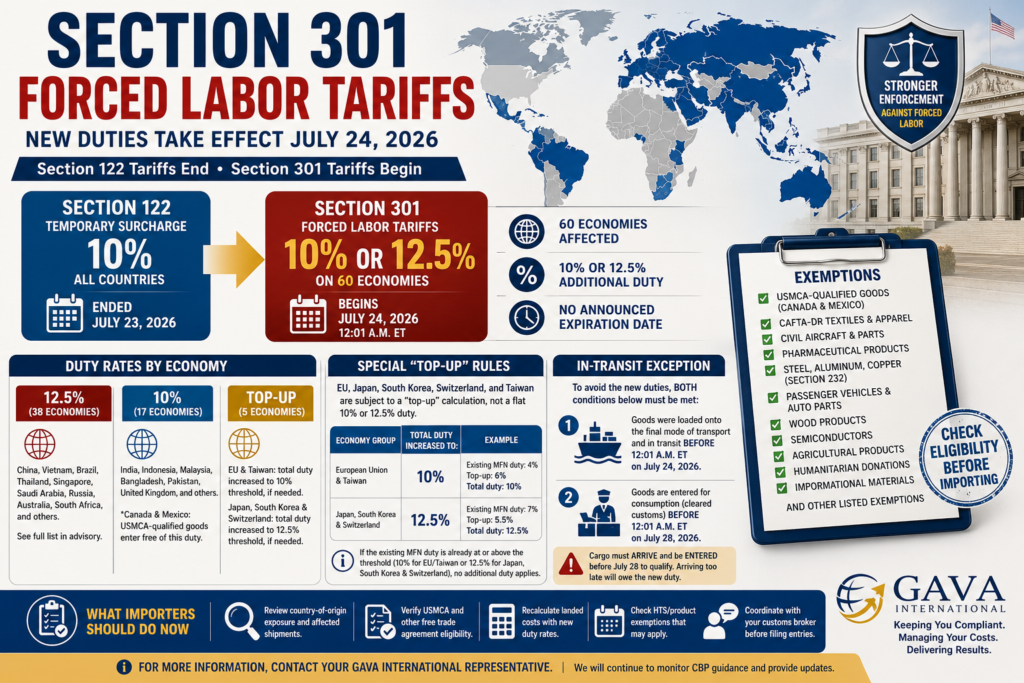
Beginning July 24, 2026, the United States will replace the temporary 10% Section 122 import surcharge with new Section 301 tariffs targeting imports from 60 economies based on forced labor enforcement policies.
The new tariffs, announced by the Office of the U.S. Trade Representative (USTR), will apply additional duties of 10% or 12.5%, depending on the country of origin.
For many importers, this represents a continuation of higher import costs, while others may see an increase in duties or qualify for important exemptions.
Why Are These New Tariffs Being Imposed?
The new duties follow a Section 301 investigation initiated earlier this year into whether trading partners adequately prohibit imports produced with forced labor.
According to USTR:
- Countries with stronger forced labor import restrictions generally receive a 10% additional duty.
- Countries that have not implemented similar enforcement measures generally receive a 12.5% additional duty.
Unlike the temporary Section 122 tariff, these new duties do not currently have an expiration date.
Important Dates Importers Should Know
| Date | Event |
|---|---|
| February 24, 2026 | Section 122 temporary 10% tariff begins |
| July 23, 2026 | USTR announces final Section 301 action |
| July 24, 2026 | Section 122 expires and new Section 301 tariffs begin |
| July 28, 2026 | Deadline for qualifying in-transit cargo exemption |
Which Countries Are Affected?
The new action covers 60 economies, including many of the United States’ largest trading partners.
Examples include:
12.5% Additional Duty
- China
- Vietnam
- Brazil
- Thailand
- Singapore
- Australia
- South Africa
- Saudi Arabia
- Russia
- United Arab Emirates
10% Additional Duty
- India
- Indonesia
- Malaysia
- Bangladesh
- Pakistan
- Canada*
- Mexico*
- United Kingdom
*USMCA-qualified goods remain exempt.
Several additional economies—including the European Union, Japan, South Korea, Switzerland, and Taiwan—will follow a special “top-up” calculation rather than a flat tariff.
Special “Top-Up” Rules for the European Union, Japan, South Korea, Switzerland, and Taiwan
Unlike most countries, imports from the European Union, Japan, South Korea, Switzerland, and Taiwan are not automatically subject to a flat 10% or 12.5% additional duty. Instead, these economies follow a “top-up” calculation.
Under this approach, CBP compares the product’s existing Normal Trade Relations (Column 1/MFN) duty rate to a specified threshold:
- European Union and Taiwan: Total duty is increased to 10%, if necessary.
- Japan, South Korea, and Switzerland: Total duty is increased to 12.5%, if necessary.
Example (European Union):
- Existing MFN duty: 4%
- Section 301 top-up: 6%
- Total duty owed: 10%
If the existing MFN duty is already 10% or higher (EU/Taiwan) or 12.5% or higher (Japan, South Korea, Switzerland), no additional Section 301 duty applies.
Key Point: This is not an additional flat tariff. The Section 301 duty only increases the total duty rate up to the applicable threshold.
How the Transition Works
The temporary Section 122 tariff automatically expires at 12:01 a.m. ET on July 24, 2026.
At that exact moment, the new Section 301 tariffs become effective.
| Section 122 | New Section 301 |
|---|---|
| 10% worldwide surcharge | 10% or 12.5% depending on country |
| Temporary (150 days) | No announced expiration |
| Applied globally | Applies to 60 specified economies |
In-Transit Cargo Rules
Importers should pay close attention to shipments already moving to the United States.
A shipment avoids the new tariffs only if BOTH conditions are met:
✅ Loaded onto its final mode of transportation before July 24
AND
✅ Entered into U.S. Customs before July 28
If cargo misses the customs entry deadline, the new Section 301 tariff will apply—even if it departed before July 24.
Major Exemptions
Several important exemptions remain available.
Examples include:
- USMCA-qualified imports from Canada and Mexico
- Certain CAFTA-DR textile and apparel products
- Civil aircraft and parts
- Certain pharmaceutical products
- Steel, aluminum, and copper products already covered under Section 232
- Passenger vehicles and certain automotive parts
- Wood products
- Semiconductor products
- Certain agricultural products
- Humanitarian donations
- Informational materials
Importers should verify whether their products qualify before assuming additional duties apply.
What Importers Should Do Now
Companies importing affected products should:
- Review country-of-origin exposure
- Identify shipments arriving after July 24
- Verify USMCA or other free trade agreement eligibility
- Review available HTS product exemptions
- Update landed-cost calculations
- Coordinate with their customs broker before filing entries
Early planning may help reduce unexpected duty costs and avoid customs delays.
Key Takeaways
✔ Section 122 tariffs expire on July 24, 2026
✔ New Section 301 forced labor tariffs immediately replace them
✔ Rates are 10% or 12.5%, depending on the country
✔ 60 economies are affected
✔ Important in-transit exemption ends July 28
✔ Numerous product and free trade agreement exemptions remain available
✔ Importers should review sourcing, HTS classifications, and customs entry timing immediately
As additional CBP guidance and Federal Register notices are released, Gava International will continue providing updates to help importers remain compliant and manage duty costs.
Reference: 301 Investigation Final Action FRN 7-23-26