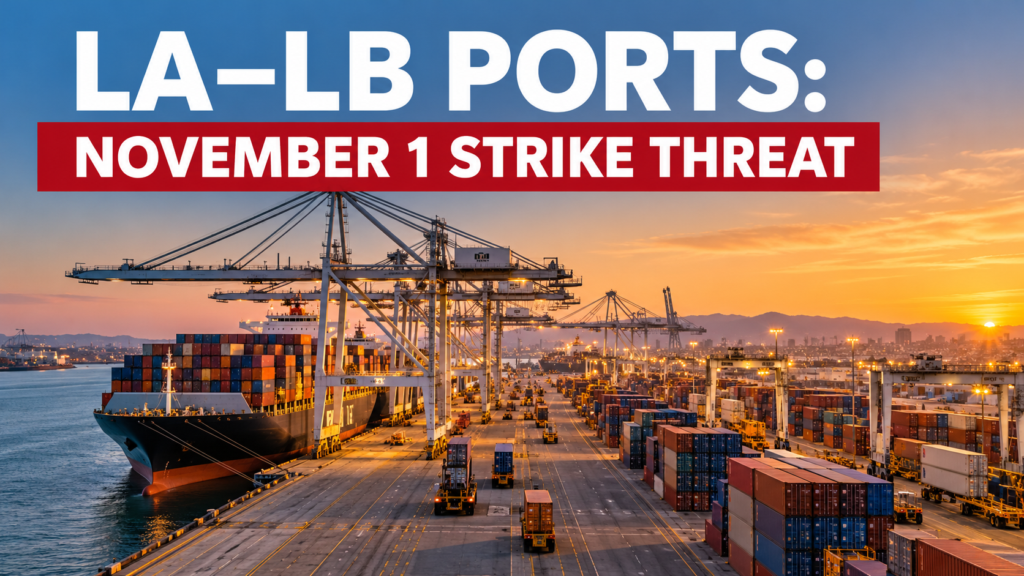
Importers and logistics providers moving cargo through the Ports of Los Angeles and Long Beach could face additional disruptions beginning Sunday, November 1, 2026, as approximately 250 unionized security personnel represented by International Longshore and Warehouse Union (ILWU) Local 26 threaten to strike at six container terminals.
The potential work stoppage comes at a particularly challenging time for Southern California’s ports, where elevated container volumes, rail congestion, and longer cargo dwell times are already affecting the movement of imported merchandise.
Although negotiations remain ongoing, a strike could have consequences extending well beyond the security personnel directly involved.
Labor Negotiations Remain Unresolved
ILWU Local 26 represents approximately 250 watchmen responsible for security operations at six marine terminals within the Los Angeles–Long Beach port complex.
The union’s previous labor agreement with maritime employers expired in July 2025. Since then, negotiations have continued between Local 26 and employers represented by the Pacific Maritime Association (PMA), with assistance from the Federal Mediation and Conciliation Service.
PMA maintains that it remains committed to reaching an agreement through collective bargaining and has urged the union to avoid a work stoppage.
According to PMA, significant differences remain between the parties despite continued negotiations.
Why a Strike Involving 250 Watchmen Could Affect Entire Terminals
While the threatened strike involves a relatively small group of security personnel, its potential impact could be considerably larger.
The primary concern is that Local 26 members could establish picket lines at the six terminals where they work.
Other ILWU-represented workers may decline to cross those picket lines, potentially affecting:
- Vessel loading and unloading operations
- Container yard operations
- Truck gates and appointment availability
- Import container pickups and export deliveries
- Rail transfers and intermodal cargo movements
PMA has warned that a work stoppage could halt vessel, yard, and gate operations at affected terminals if other union members do not cross Local 26 picket lines.
A strike involving approximately 250 security workers could therefore disrupt operations involving thousands of containers and other port personnel.
The extent of any disruption would depend on which terminals are affected, whether picket lines are established, and how other workers respond.
Existing Port Congestion Adds to the Risk
The threatened labor action comes as the Southern California port complex is already managing substantial cargo volumes.
Several months of record or near-record container traffic have contributed to increasing pressure on terminal operations and inland transportation networks.
Of particular concern are growing rail container backlogs and longer dwell times, which can reduce terminal capacity and complicate the movement of import cargo.
An interruption at even a portion of the port complex could intensify these existing challenges.
Importers could experience additional delays in container availability, trucking appointments, and final delivery schedules.
For shipments already approaching their last free day, operational disruptions may also increase exposure to demurrage, detention, storage, and related transportation costs, depending on terminal and carrier policies.
Potential Impact on Holiday Merchandise
The timing of the threatened strike is especially concerning for retailers and importers moving merchandise ahead of the holiday shopping season.
A disruption beginning November 1 could affect cargo intended for distribution centers and retail stores across the United States.
Even a relatively short interruption could create a backlog of containers awaiting discharge, terminal release, trucking appointments, or rail transportation.
The resulting congestion could take additional time to clear after normal operations resume.
Port Officials Encourage Continued Negotiations
The Port of Los Angeles has urged the parties to continue negotiating in good faith and reach an agreement that avoids disrupting cargo operations.
The port emphasized the importance of maintaining the movement of goods while recognizing the interests of both labor and employers.
At this stage, the threatened strike does not necessarily mean that terminal operations will stop. Negotiations could still produce an agreement or an extension that prevents a work stoppage.
Nevertheless, importers should prepare for possible disruptions rather than assume that cargo movements will continue without interruption.
GAVA Is Monitoring Developments
Gava continues to monitor the labor negotiations and operating conditions at the Ports of Los Angeles and Long Beach.
Our team is coordinating with ocean carriers, marine terminals, and trucking providers to identify potential disruptions and assist customers with their import and export shipments.
We encourage customers with time-sensitive cargo moving through Southern California to contact their GAVA representative to review shipment status and available transportation options.
We will provide additional updates as developments become available.
Key Takeaways
- ILWU Local 26 has threatened a strike beginning November 1, 2026, involving approximately 250 security personnel at six container terminals.
- Other ILWU workers may decline to cross picket lines, potentially disrupting vessel, yard, and truck gate operations.
- Existing congestion and rail backlogs could amplify the effects of a work stoppage.
- Importers should closely monitor container availability, last free days, trucking appointments, and delivery schedules.
- Negotiations remain ongoing, and a strike is not inevitable.