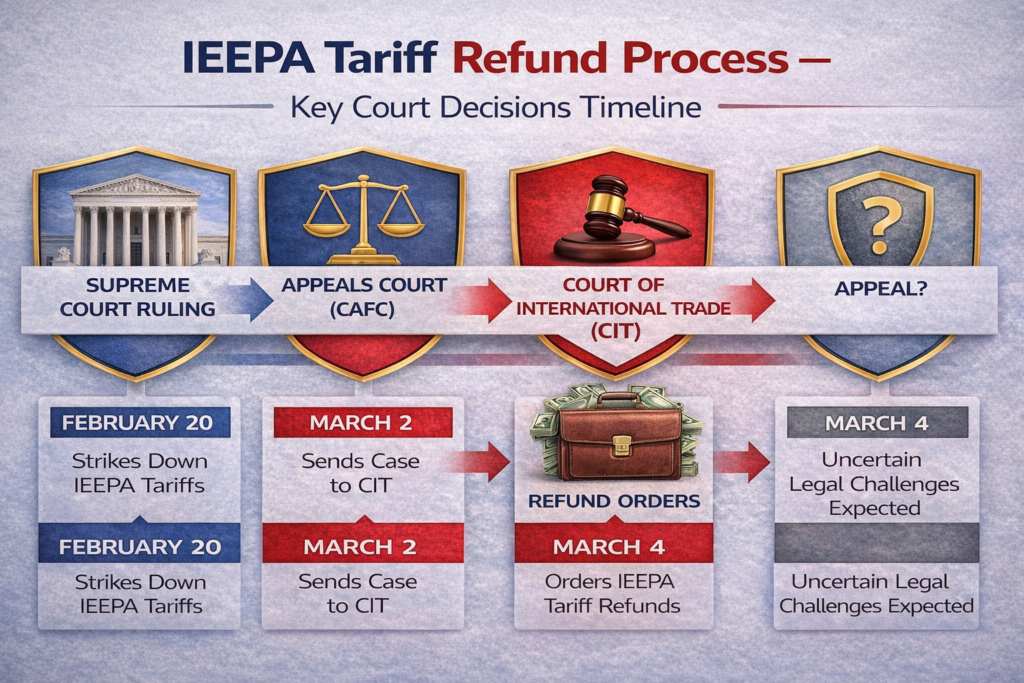
The U.S. Court of International Trade (CIT) issued an order on March 4 directing U.S. Customs and Border Protection (CBP) to begin implementing IEEPA tariff refunds following the Supreme Court decision invalidating tariffs imposed under the International Emergency Economic Powers Act (IEEPA).
Specifically, the court instructed CBP to:
-
Liquidate unliquidated entries without regard to IEEPA duties, and
-
Reliquidate entries that have already liquidated but are not yet final.
The order potentially opens the door for refunds to importers that paid the now-invalidated tariffs.
Why an Appeal Is Likely
Despite the court’s directive, the order may face immediate appeal.
Legal observers note several concerns that could trigger appellate review, including:
-
Procedural deficiencies in how the order was issued
-
The broad or “universal” scope of the ruling
-
Questions regarding whether the court can grant relief affecting all importers rather than only the litigants
Because of these factors, the Department of Justice (DOJ) is expected to challenge the decision.
Upcoming Court Proceedings
CIT Judge Richard K. Eaton, who issued the order, scheduled a non-public conference for March 6 at 10 a.m. to discuss the next phase of proceedings and potentially outline the framework for the refund process.
Judge Eaton also indicated that he intends to oversee all related refund issues, including those connected to the V.O.S. Selections case, which played a central role in the litigation.
Court’s Position on the Refund Process
During discussion of the order, Judge Eaton emphasized that the refund process should not become chaotic. He suggested that CBP should be able to process refunds through its existing administrative procedures.
The court also signaled a preference to avoid forcing importers to file individual lawsuits in order to obtain refunds. The judge noted that the court does not want to handle a large influx of additional cases.
However, the practical impact of the order remains uncertain.
Government Position on Refund Claims
The Department of Justice argued that importers whose entries have already liquidated may need to file suit to obtain refunds. It remains unclear whether the government’s position refers to:
-
Entries that have liquidated but remain within the protest period, or
-
Entries that have reached final liquidation.
This issue will likely become a central dispute as the refund process develops.
Why the Order May Face Legal Challenges
Another point of contention is how the refund issue was introduced.
According to observers, the judge addressed refunds within a ruling on a separate motion that had already been withdrawn, which could raise procedural concerns.
Because of this unusual procedural posture, the order could be challenged as impermissibly broad in its application.
What Importers Should Watch Next
Although the CIT has directed CBP to begin implementing IEEPA tariff refunds, this order is not necessarily the final word on the issue.
Several developments may still occur:
-
A DOJ appeal to the Court of Appeals for the Federal Circuit
-
Further clarification from the CIT regarding refund procedures
-
Additional guidance from CBP on how refunds will be processed
-
Possible limitations on which importers qualify for relief
For now, importers should continue monitoring liquidation timelines and court developments closely.