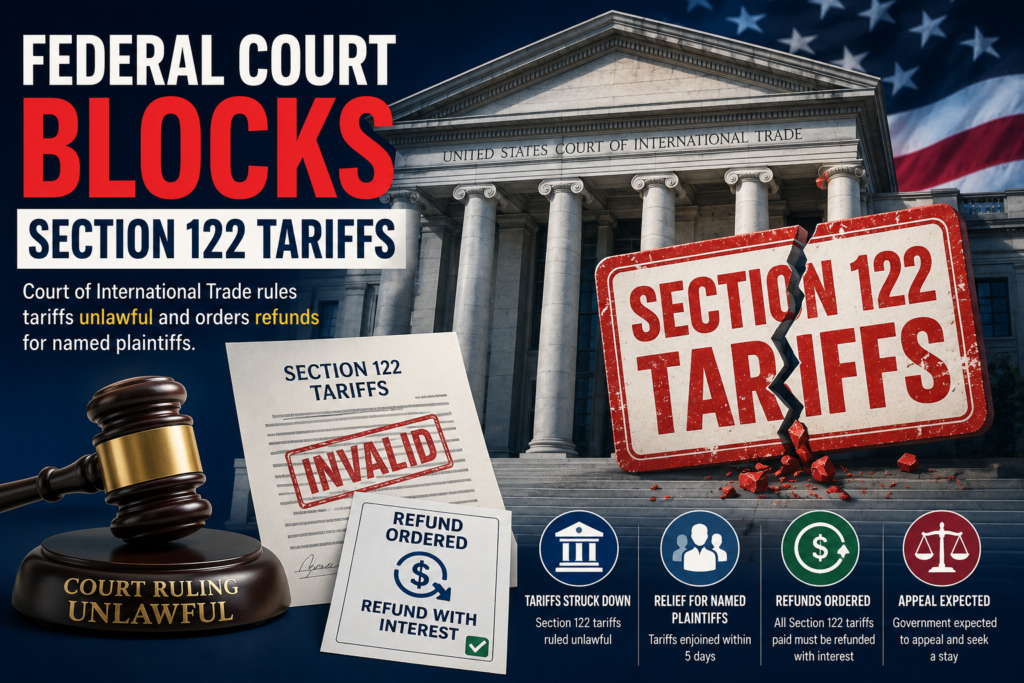
Court of International Trade Strikes Down Section 122 Tariffs
In a significant trade ruling issued on May 7, the U.S. Court of International Trade (CIT) ruled that the Section 122 tariffs imposed by the Trump Administration are unlawful.
The decision, issued in a 2–1 split ruling, represents another major legal challenge to recent U.S. tariff actions and could have important implications for importers seeking tariff relief or refunds.
Why the Court Invalidated the Section 122 Tariffs
The majority of the court concluded that the administration failed to properly justify the tariffs under the legal requirements of Section 122 of the Trade Act of 1974.
According to the ruling, Section 122 allows tariffs only when there is a serious balance-of-payments deficit. However, the court found that the administration relied on broader economic indicators instead.
The President’s proclamation referenced:
- Large trade deficits
- Current account deficits
- Negative international investment positions
- Deficits in primary and secondary income balances
The court determined that these factors do not legally qualify as a “balance-of-payments deficit” under the original meaning of Section 122.
Refunds Ordered — But Only for Named Plaintiffs
Importantly, the court did not issue a nationwide injunction.
Instead, the ruling applies only to the specific plaintiffs involved in the lawsuit, including certain importers and the State of Washington acting as an importer.
The court ordered:
- The government must stop applying Section 122 tariffs to the named plaintiffs within 5 days
- Previously paid Section 122 tariffs must be refunded with interest
Why the Court Limited the Decision
The majority declined to extend relief universally to all importers.
The judges explained that:
Increased costs to other companies alone were not enough to justify a nationwide injunction.
However, the court acknowledged that refund delays in prior tariff litigation — particularly the ongoing IEEPA tariff refund process — influenced its decision to provide immediate relief to the named parties.
The Dissenting Opinion
Judge Timothy Stanceu dissented from the majority decision.
He argued that the court should not assume the administration ignored balance-of-payments concerns simply because it relied on broader economic data.
According to the dissent:
- Trade deficits and current account deficits may still support Section 122 authority
- The government should have been allowed to further develop its factual arguments before summary judgment was granted
The dissent also questioned whether the procedural handling of the case was appropriate.
Appeal Expected Quickly
The Department of Justice is expected to:
- Appeal the decision rapidly
- Request a stay to temporarily preserve the tariffs during the appeals process
As a result, the legal status of the Section 122 tariffs remains uncertain.
What This Means for Importers
At this stage:
- No immediate action is required for most importers
- Refund eligibility currently applies only to the named plaintiffs
- Additional litigation or administrative remedies may emerge
Potential future options may include:
- Filing protests
- Seeking injunctions
- Using future CAPE-related refund mechanisms if expanded
The situation remains highly dynamic, and further court rulings could significantly impact refund eligibility and tariff enforcement.
Key Takeaways
✔ CIT ruled Section 122 tariffs unlawful
✔ Refunds ordered for named plaintiffs only
✔ No nationwide injunction issued
✔ Government expected to appeal immediately
✔ Importers should continue monitoring developments closely