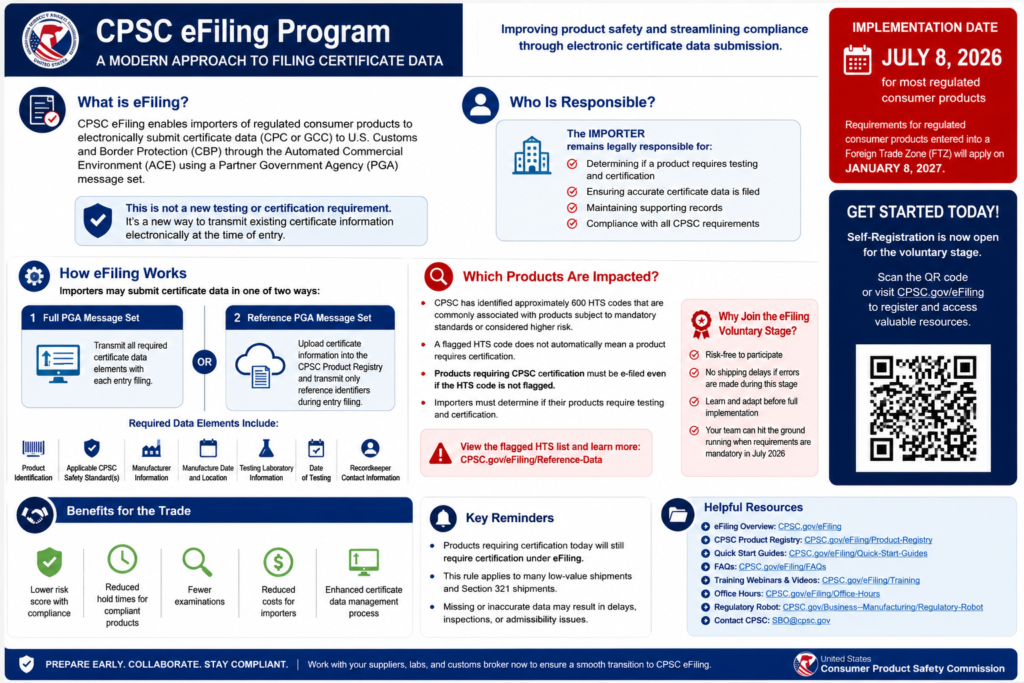
The U.S. Consumer Product Safety Commission (CPSC) is implementing a new electronic filing requirement for imported consumer products beginning July 8, 2026. The new program, known as CPSC eFiling, is designed to improve product safety screening and increase visibility into imported products subject to CPSC regulations.
Under the new rule, importers of regulated consumer products must electronically transmit product certificate data to U.S. Customs and Border Protection (CBP) through the Automated Commercial Environment (ACE) at the time of entry.
Importantly, this rule does not create new product testing or certification requirements. Instead, it changes how existing compliance information is submitted to the government.
What Is CPSC eFiling?
CPSC eFiling requires importers to electronically submit data related to:
- Children’s Product Certificates (CPCs)
- General Certificates of Conformity (GCCs)
These certificates confirm that products comply with applicable U.S. consumer product safety standards.
Additional information about the program is available directly from the CPSC:
https://www.cpsc.gov/eFiling
What Information Must Be Submitted?
Required certificate data generally includes:
- Product identification
- Applicable CPSC safety standard(s)
- Manufacturer information
- Manufacture date and location
- Testing laboratory information
- Date of testing
- Recordkeeper contact information
Importers will have two filing options:
1. Full PGA Message Set
Transmit all required certificate data with each shipment filing through ACE.
2. Reference PGA Message Set
Upload certificate information into the CPSC Product Registry and transmit only reference identifiers at entry.
CPSC Product Registry:
https://www.cpsc.gov/eFiling-CPSC-Product-Registry
Which Products Are Impacted?
The CPSC has identified approximately 600 Harmonized Tariff Schedule (HTS) codes that are commonly associated with products subject to mandatory safety standards or considered higher risk.
However:
- A flagged HTS code does not automatically mean a product requires certification.
- Products requiring CPSC certification must still be e-filed even if the HTS code is not on the flagged list.
- Importers remain responsible for determining whether their products require testing and certification.
The HTS list is intended to help the trade community understand when CPSC and CBP may flag shipments for additional review and when voluntary disclaimer messages may be appropriate.
The Underlying Compliance Rules Have NOT Changed
One of the most important points for importers to understand is that the new eFiling rule does not introduce new safety standards.
If a product already required:
- testing,
- certification,
- a CPC, or
- a GCC,
those obligations already existed under current law.
The difference beginning July 8 is that certificate data must now be submitted electronically at the time of importation, making compliance gaps more visible to regulators.
Many importers may discover they were previously unaware that certain products already required CPSC certification.
Importers Should Begin Preparing Now
Preparing for eFiling requires coordination across multiple departments and business partners — not just the customs team.
Recommended stakeholders include:
- Product management
- Regulatory and compliance teams
- Suppliers and manufacturers
- Testing laboratories
- Customs brokers
Importers should begin evaluating:
- Which products require testing and certification
- Whether valid CPCs or GCCs exist
- How certificates are stored and maintained
- Whether suppliers and labs are prepared to support eFiling requirements
What If an Importer Has No Existing CPSC Compliance Program?
Companies unfamiliar with CPSC requirements should begin reviewing their products immediately.
The CPSC offers several tools and resources to help importers determine applicability, including the:
Regulatory Robot
A self-service tool that helps determine whether a product requires:
- a Children’s Product Certificate (CPC), or
- a General Certificate of Conformity (GCC)
Regulatory Robot:
https://www.cpsc.gov/Business–Manufacturing/Regulatory-Robot
If the Regulatory Robot does not provide a clear determination, importers may contact the CPSC directly at:
Some companies may also benefit from working with specialized CPSC compliance consultants or accredited testing laboratories.
The Role of Customs Brokers
Customs brokers can assist importers by:
- Providing educational resources
- Coordinating filing procedures
- Supporting data transmission processes
- Assisting with ACE implementation planning
However, customs brokers cannot determine whether a product legally requires CPSC testing or certification.
The importer remains ultimately responsible for:
- product classification,
- testing requirements,
- certification obligations, and
- compliance accuracy.
Additional Resources Available to Importers
The CPSC eFiling portal includes:
- Quick Start Guides
- Frequently Asked Questions (FAQs)
- Training webinars
- Office Hours with CPSC staff
- Business account registration tools
- Product Registry resources
- Technical implementation guidance
CPSC eFiling Resources:
https://www.cpsc.gov/eFiling
Final Thoughts
With the July 8, 2026 implementation date approaching, importers should begin preparing now to avoid potential shipment delays, cargo holds, examinations, or admissibility issues.
Advance coordination between importers, manufacturers, suppliers, laboratories, and customs brokers will be essential for a smooth transition to the new eFiling environment.
Companies importing consumer products into the United States should review their current testing and certification programs immediately and ensure they are prepared to transmit accurate certificate data electronically at the time of entry.