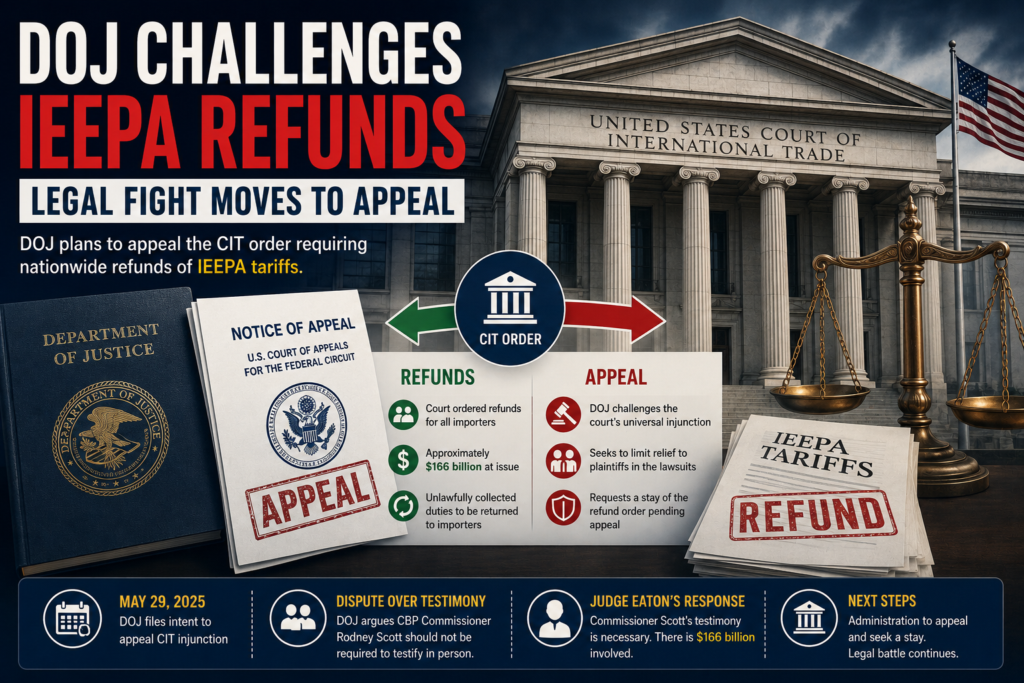
The legal battle over IEEPA tariff refunds continues to intensify as the U.S. Department of Justice (DOJ) announced its intention to appeal the Court of International Trade’s (CIT) order requiring the refund of tariffs collected under the International Emergency Economic Powers Act (IEEPA).
The filing, submitted on May 29, signals that the Trump Administration intends to challenge the court’s authority to order refunds on a nationwide basis and could significantly impact how and when importers receive tariff refunds.
DOJ Opposes Nationwide Refund Order
In its filing, the DOJ argued that the Court of International Trade exceeded its authority by ordering Customs and Border Protection (CBP) to reliquidate entries and refund duties for importers who were not parties to the litigation.
According to the government:
The court issued a universal injunction that extends beyond the specific plaintiffs involved in the case.
The DOJ indicated that it plans to rely on the Supreme Court’s decision in Trump v. CASA, Inc. (2025) to argue that broad nationwide injunctions are generally inappropriate unless specifically authorized by law.
Administration Plans to Seek a Stay
The filing also confirms that the government intends to:
- Appeal the CIT ruling
- Request a stay of the refund order
- Limit any relief to the importers that actually participated in the lawsuits
If granted, a stay could temporarily pause portions of the refund process while appellate courts review the case.
Dispute Over Commissioner Testimony
Another issue raised in the DOJ filing concerns CBP Commissioner Rodney Scott.
Judge Richard Eaton previously ordered Commissioner Scott to appear before the court on June 9 to discuss how CBP intends to implement refunds.
The DOJ objected, arguing that senior CBP officials already involved in the refund process should continue representing the agency instead.
The government proposed that:
- Susan Thomas
- Brandon Lord
remain the primary CBP representatives before the court.
Judge Eaton Emphasizes Scope of Refund Issue
Judge Eaton responded directly to the DOJ’s filing, stating that Commissioner Scott’s testimony remains important because the court must determine whether the government intends to refund unlawfully collected duties to all affected importers.
According to the judge, the issue extends far beyond the named plaintiffs because:
Approximately $166 billion in tariff collections may be affected.
The court is seeking clarity on whether the government intends to comply with the refund order voluntarily or pursue an alternative approach.
What This Means for Importers
At this stage, no immediate action is required for most importers.
However, the DOJ’s position suggests that the government may continue fighting efforts to make refunds broadly available across the importing community.
Key issues to watch include:
- Whether a stay is granted
- The outcome of the appeal
- Whether refunds will be limited to named plaintiffs
- Future guidance from CBP regarding refund eligibility and processing
Key Takeaways
✔ DOJ intends to appeal the CIT refund order
✔ Government challenges nationwide refund relief
✔ Administration seeks to limit refunds to lawsuit participants
✔ Judge Eaton continues to press for clarification on refund plans
✔ Approximately $166 billion in tariff collections remain at issue