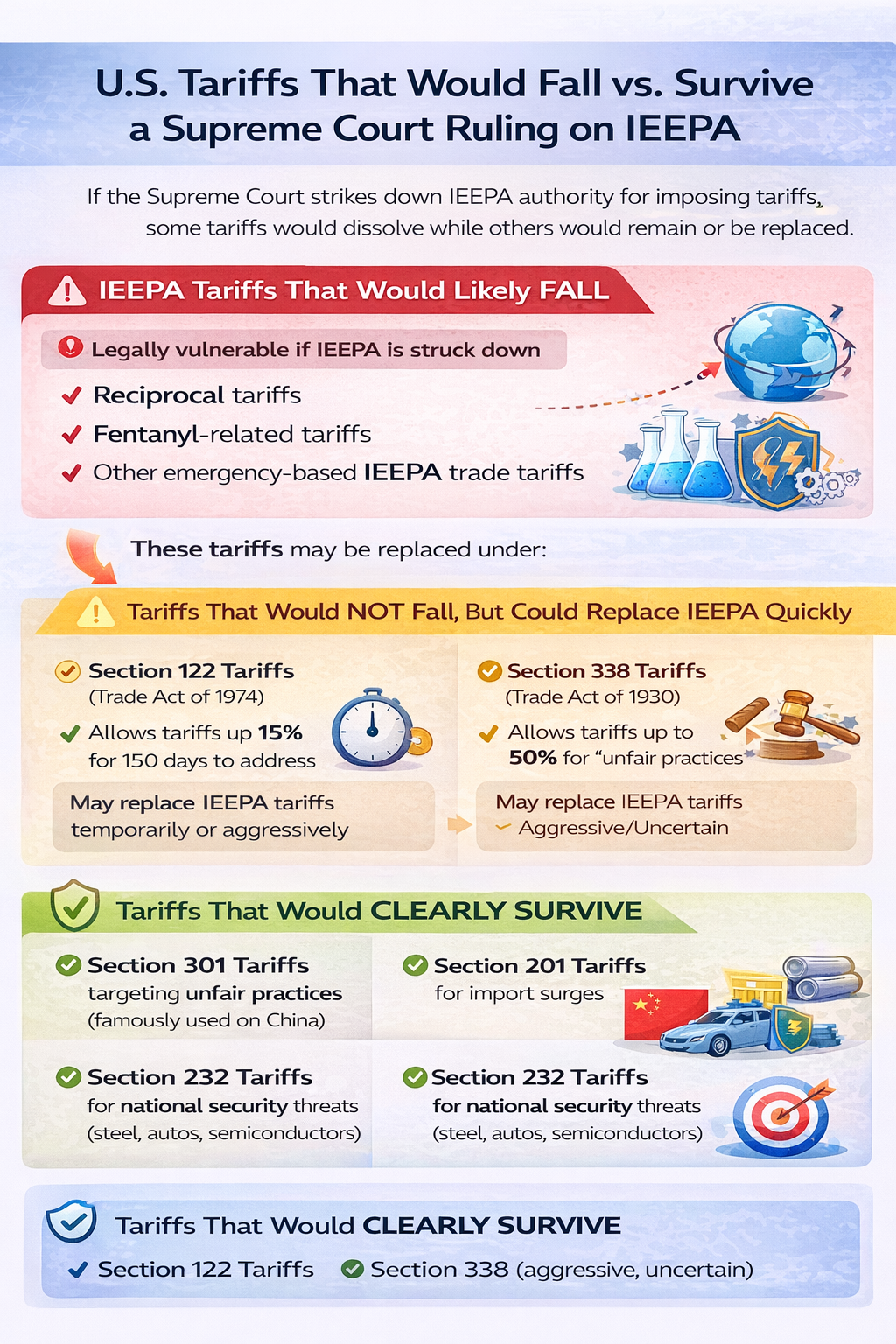
A pending U.S. Supreme Court ruling on tariffs imposed under the International Emergency Economic Powers Act (IEEPA) could temporarily reduce U.S. tariff rates — but analysts warn the relief may be short-lived.
According to recent analysis from J.P. Morgan, the court’s decision is unlikely to bring lasting tariff relief, as the administration is expected to quickly replace any struck-down tariffs using alternative legal authorities.
What Are IEEPA Tariffs?
IEEPA tariffs are trade duties imposed by the President under the International Emergency Economic Powers Act (IEEPA).
They are imposed when the President declares a national emergency, granting broad authority to restrict trade or impose duties without prior congressional approval.
Over the past year, IEEPA has become a central tool for U.S. trade policy, contributing significantly to higher average tariff rates across multiple countries.
In simple terms:
-
The President claims an emergency (economic, security, or geopolitical)
-
That emergency allows fast, broad tariff action
-
Congress approval is not required upfront
IEEPA has become one of the most powerful and flexible tariff tools because it allows wide coverage, fast implementation, and minimal procedural hurdles.
What Happens If the Supreme Court Strikes Them Down?
Legal analysts estimate a 70% chance that the Supreme Court rules against the administration’s use of IEEPA for tariffs.
If that happens:
-
The average U.S. tariff rate would fall from 16.1% to about 10.4%
-
Countries most affected would include India, Brazil, and Switzerland
-
Roughly one-third of current tariffs could be removed — temporarily
However, the administration is expected to act quickly to prevent a prolonged tariff rollback.
Replacement Tariffs Are Likely
If IEEPA tariffs are invalidated, the administration could pivot to other trade laws, including:
-
Section 122 to impose temporary tariffs up to 15%
-
Section 301 to target specific countries
-
Section 232 to apply sector-based tariffs tied to national security
-
Section 338, a rarely used but aggressive authority allowing tariffs up to 50%
This means that headline tariff reductions may be short-lived, replaced by new measures under different statutes.
Refunds and the Fiscal Impact
A ruling against IEEPA could make up to $140 billion in tariff revenue technically eligible for refunds. In practice:
-
Only companies involved in litigation are likely to receive refunds
-
Many firms may avoid legal action due to cost or political risk
From a fiscal standpoint, tariffs are projected to generate $3.7 trillion over the next decade, helping offset major federal spending initiatives. That makes a permanent tariff rollback unlikely.
Market and Business Implications
-
Short-term market volatility is likely
-
A brief equity relief rally could occur
-
Tariff-sensitive companies have already underperformed the market
-
Businesses may delay investment and hiring while trade policy remains uncertain
For investors, analysts expect near-term volatility, but long-term structural trends are likely to remain intact.
Why This Matters for Businesses
The Supreme Court case highlights a broader reality:
Tariffs have become a structural feature of U.S. trade policy, not a temporary measure.
Even if one legal authority is struck down, others are ready to take its place — keeping trade uncertainty high for importers, exporters, and investors alike.
Types of Tariff Authorities Mentioned
1. IEEPA Tariffs (Current focus of the Supreme Court case)
-
Purpose: Respond to a declared national emergency
-
Speed: Immediate
-
Scope: Broad (many countries, many products)
-
Limits: Being challenged as an overreach of executive power
-
Why it matters: These tariffs now make up a large share of total U.S. tariff rates
2. Section 122 – Trade Act of 1974
-
Purpose: Address trade imbalances
-
Tariff level: Up to 15%
-
Duration: 150 days (extensions require Congress)
-
Strength: Fast replacement tool if IEEPA is struck down
-
Weakness: Temporary unless Congress approves
3. Section 338 – Trade Act of 1930
-
Purpose: Penalize “unfair trade practices”
-
Tariff level: Up to 50%
-
Strength: Very aggressive
-
Weakness: Legally untested, likely to face immediate lawsuits
4. Section 301 – Trade Act of 1974
-
Purpose: Punish unfair or discriminatory practices
-
Scope: Country-specific (famously used on China)
-
Strength: Legally durable
-
Weakness: Slow and narrow, not ideal for replacing broad tariffs
5. Section 232 – Trade Act of 1962
-
Purpose: Protect national security
-
Scope: Sector-wide (steel, aluminum, autos, semiconductors)
-
Process: Investigation + review (up to 270 days)
-
Strength: Strong legal footing
-
Weakness: Slow to deploy