The United States is advancing another major tariff initiative that could significantly affect importers, manufacturers, retailers, and international supply chains.
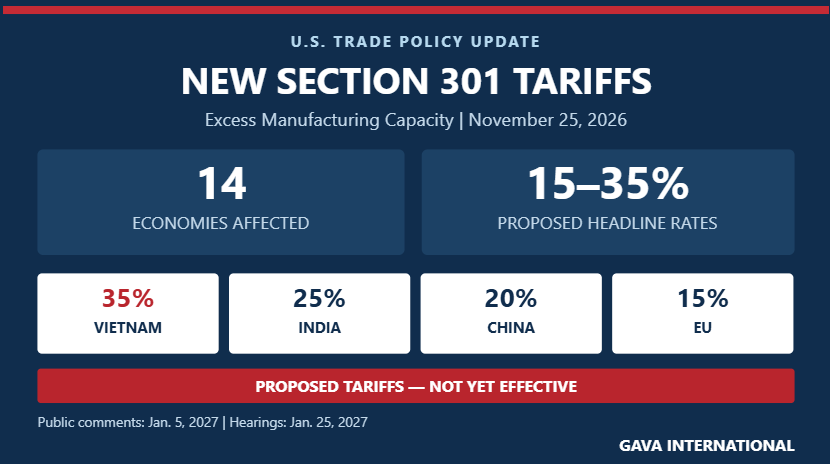
On November 25, 2026, the Office of the United States Trade Representative (USTR) announced its determinations under Section 301 of the Trade Act of 1974 concerning structural excess manufacturing capacity and production practices across 14 economies, including the European Union, China, India, Vietnam, and several major Asian trading partners.
Following its investigations, USTR determined that certain government policies and industrial practices are unreasonable and burden or restrict U.S. commerce.
As a result, USTR has proposed new Section 301 tariff measures with headline rates ranging from 15% to 35%, subject to country-specific adjustments, exemptions, existing tariffs, and ongoing trade negotiations.
Importantly, these tariffs are currently proposed measures. They have not yet entered into effect, and no implementation date has been announced in the advisory.
Why Is the United States Proposing New Section 301 Tariffs?
The investigations, originally launched on March 11, 2026, focus on government policies that allegedly contribute to excessive manufacturing capacity and distort international competition.
According to USTR, these practices include:
Government subsidies and preferential financing for manufacturers.
Industrial policies designed to expand production and exports.
Currency and financial policies that distort market conditions.
Inadequate labor protections and enforcement.
Restrictions on market access for U.S. companies.
Government support for strategically important industries.
Expansion of manufacturing capacity through investments from non-market economies.
USTR maintains that these practices negatively affect American manufacturing, employment, investment, export opportunities, and economic security.
These investigations represent a separate Section 301 initiative from the previously introduced Section 301 forced labor tariffs.
Proposed Section 301 Tariffs by Country
The following table summarizes the proposed tariff rates and the principal industries highlighted in USTR’s findings.
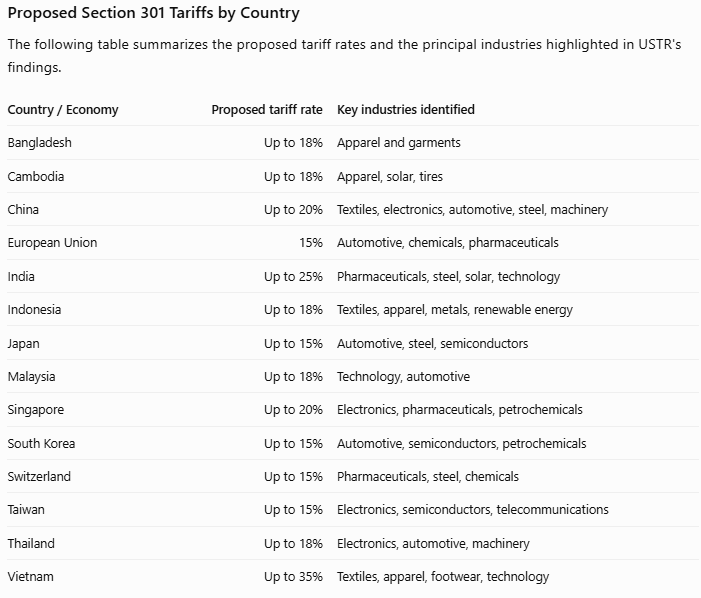
Mexico and Norway were included in the original investigations. However, USTR has not announced determinations concerning either country at this time.
Understanding How the New Section 301 Tariffs Would Be Calculated
One of the most important aspects of the proposed measures is that the announced percentages would not necessarily represent additional flat tariffs imposed on top of all existing customs duties.
USTR has proposed different calculation methodologies depending on the country of origin.
European Union, Japan, South Korea, Switzerland and Taiwan
For these five economies, USTR proposes a tariff rate of 15%, or up to 15%, calculated net of:
Existing Most Favored Nation (MFN) customs duties.
Existing Section 301 tariffs.
This would effectively operate as a tariff top-up mechanism, rather than an automatic additional 15% duty.
Bangladesh, Cambodia, Indonesia, Malaysia and Thailand
For these economies, USTR proposes tariffs of up to 18%, calculated net of existing Section 301 tariffs.
Unlike the proposed European Union methodology, ordinary MFN customs duties are not identified as an offset in these proposals.
Consequently, the potential combined duty exposure could be considerably higher, particularly for products already subject to substantial ordinary customs duties, such as textiles, apparel, and footwear.
Vietnam Faces the Highest Proposed Tariff Rate
Vietnam faces the highest proposed tariff rate among the 14 economies, at up to 35%, net of existing Section 301 tariffs.
However, USTR has also indicated that a reduced tariff rate of 20% could be considered if Vietnam reaches a satisfactory reciprocal trade agreement with the United States.
Potential Tariff Reductions Through Trade Negotiations
Several proposed tariff rates could be reduced depending on the outcome of bilateral trade negotiations.
China: Special Tariff Treatment and Product Exemptions
China’s proposed tariff structure differs from that of the other investigated economies.
USTR is considering:
Tariffs of up to 20% on goods not identified in the relevant annexes, net of the applicable Section 301 forced labor tariff.
Tariffs of up to 10% on products identified in Annex A.
Exemptions for certain products identified in Annex B.
The proposal also takes into consideration commitments made under the Kuala Lumpur Joint Arrangement reached between the United States and China on October 30, 2025.
Importers sourcing products from China should carefully review the applicable Federal Register annexes and existing Section 301 obligations before estimating their potential duty exposure.
How Could the New Tariffs Affect the Fashion and Apparel Industry?
The proposed measures are particularly relevant to U.S. importers of textiles, apparel, footwear, and fashion accessories.
Several of the world’s largest apparel manufacturing economies are directly affected.
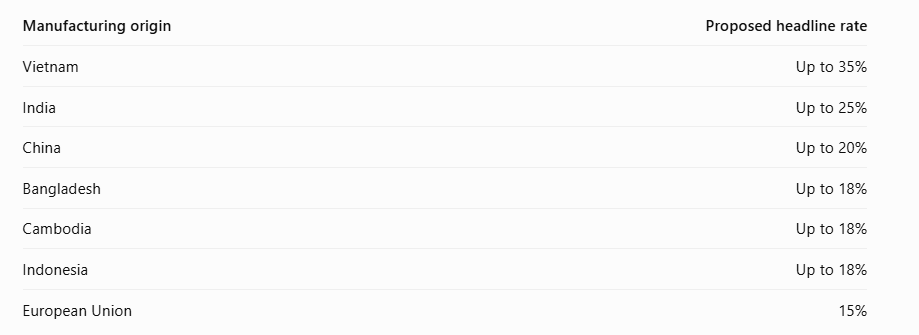
Because many apparel products already carry relatively high MFN duty rates, additional Section 301 measures could substantially increase landed costs, depending on the country-specific calculation methodology.
Importers should avoid assuming that relocating production from China to another Asian manufacturing country will automatically reduce their overall tariff exposure.
Country of origin, HTSUS classification, existing trade remedies, and potential product exemptions will remain critical factors in sourcing decisions.
Key Takeaways
USTR has proposed new Section 301 tariffs targeting structural excess manufacturing capacity across 14 economies.
Proposed headline tariff rates range from 15% to 35%.
Vietnam faces the highest proposed rate, at up to 35%.
The European Union and four other economies would benefit from a proposed calculation that offsets existing MFN and Section 301 duties.
Mexico and Norway remain under investigation without announced determinations.
Certain products may qualify for exemptions.
Public comments are due January 5, 2027.
Public hearings are scheduled to begin January 25, 2027.
The proposed tariffs are not yet effective.