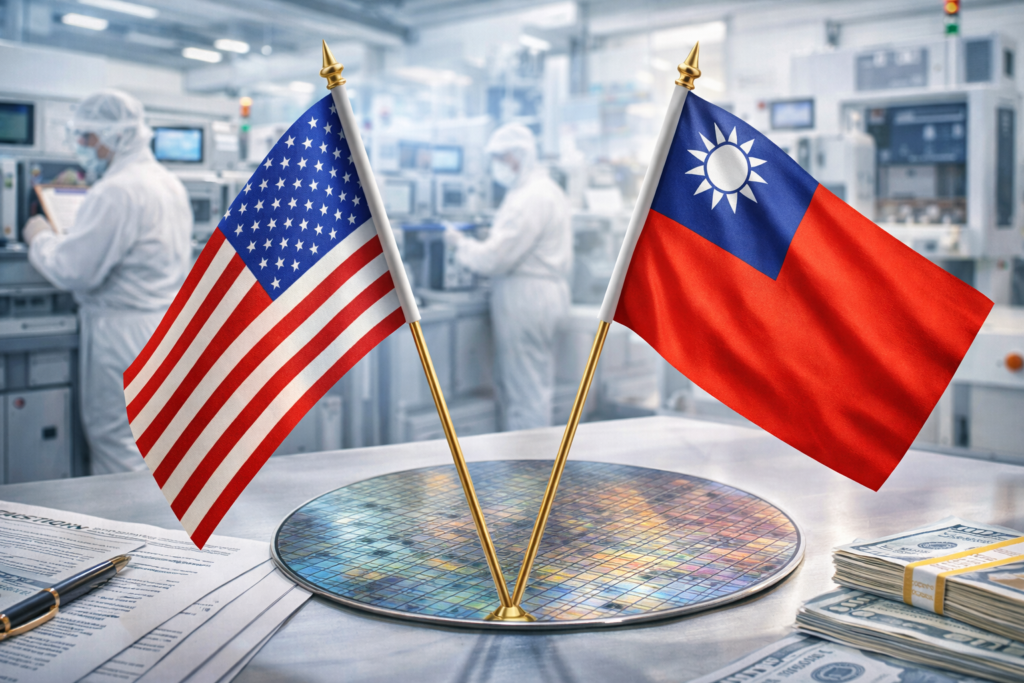
The United States and Taiwan have signed a new Reciprocal Trade Agreement aimed at expanding bilateral trade and strengthening market access across key industrial and agricultural sectors.
U.S. Trade Representative Jamieson Greer and Taiwan’s Vice Premier Li-chiun Cheng formalized the agreement on February 12.
What Taiwan Agreed To
Under the agreement, Taiwan will eliminate or reduce 99% of tariff barriers on U.S. goods, significantly expanding access for American exporters.
Industrial Goods Covered
Taiwan will provide preferential treatment for U.S. exports including:
Automobiles and auto parts / Chemicals / Machinery / Electrical products / Health products and medical devices / Metals and minerals / Seafood
This move enhances competitiveness for U.S. manufacturers and technology suppliers operating in the Asia-Pacific region.
Agricultural Market Access Expansion
Taiwan also committed to expanded access for U.S. agricultural products, including:
Horticultural products / Wheat / Beef and beef products / Dairy products / Pork and pork products / Lamb and sheep meat / Tree nuts / Pet food /Processed goods such as ketchup and peanuts
These measures are expected to reduce regulatory friction and strengthen U.S. agricultural export volumes.
Addressing Non-Tariff Barriers
Beyond tariffs, Taiwan committed to resolving non-tariff barriers that have historically affected:
-
U.S. motor vehicle exports
-
Medical devices
-
Pharmaceutical products
Non-tariff barriers typically include regulatory standards, certification requirements, or licensing processes that can restrict trade even when tariffs are low.
Reducing these barriers improves predictability and lowers compliance costs for exporters.
U.S. Tariff Treatment Under the Agreement
In exchange for Taiwan’s commitments, the United States agreed to reduce certain tariff rates applied to originating goods from Taiwan.
Under the framework:
-
The U.S. will apply the higher of:
-
The standard Most Favored Nation (MFN) tariff rate, or
-
A 15% tariff rate, which includes the MFN tariff plus a reciprocal tariff component under Executive Order 14257 (April 2, 2025), as amended.
-
What This Means
The 15% rate functions as a ceiling under the reciprocal tariff structure. If the MFN rate exceeds 15%, the higher MFN rate applies. If the MFN rate is below 15%, the combined reciprocal tariff framework brings the total rate to 15%.
This maintains consistency with the broader U.S. reciprocal tariff policy introduced in 2025.
Strategic Context
The agreement reinforces U.S.–Taiwan economic ties at a time when semiconductor supply chains, advanced manufacturing, and agricultural trade remain central to U.S. trade policy.
While reciprocal tariffs remain part of the U.S. framework, the agreement signals structured trade cooperation rather than unilateral tariff escalation.
Frequently Asked Questions
What percentage of tariffs is Taiwan eliminating?
Taiwan will eliminate or reduce 99% of tariff barriers on U.S. goods.
What industries benefit most?
U.S. automotive, industrial manufacturing, medical device, pharmaceutical, and agricultural exporters.
What tariff rate will the U.S. apply to Taiwanese goods?
The U.S. will apply the higher of the MFN tariff rate or a total 15% rate under the reciprocal tariff framework.
Does this remove reciprocal tariffs?
No. The agreement integrates Taiwan into the existing reciprocal tariff structure while adjusting specific rates.